
Water Filtration

Commercial water filtration for hydroponic and CEA systems
Integrated Water Process plans, specifies and supplies water filtration systems for commercial greenhouses, indoor growing facilities and other controlled-environment agriculture (CEA) applications. Filtration is selected around the water source, required flow, downstream equipment and the water quality needed for the intended process.
Our Total Water Management approach treats filtration as one part of the complete water system. Source-water filtration, irrigation filtration, membrane treatment and reclaimed-water treatment can serve different purposes and may require different equipment, controls and maintenance strategies.
The objective is not to install the finest filter available. It is to remove the particles or dissolved constituents that matter to the application while maintaining the required flow, pressure, reliability and serviceability of the overall system.
Start with the water and the equipment it needs to protect
Filter selection begins with understanding what is present in the water and what downstream processes need protection. Source-water conditions, suspended solids, turbidity, dissolved minerals, organic material, irrigation emitter requirements and treatment objectives can all influence the filtration strategy.
Water analysis can help identify dissolved constituents, while particle loading and operational observations can help define suspended-solids requirements. The intended use of the filtered water then establishes how much treatment is appropriate.
Our water testing and analysis services can help characterize source or process water before major treatment decisions are made.
Protect pumps, valves, instruments and irrigation equipment
Particulate filtration can protect pumps, valves, flow meters, pressure regulators, treatment equipment and irrigation emitters from debris and suspended solids. The required filtration level should be coordinated with the smallest or most sensitive downstream passages rather than selected independently from the equipment being protected.
Filters also introduce pressure loss into the system. As debris accumulates, differential pressure can increase and available downstream pressure can decrease. Pumping, filter sizing, cleaning cycles and controls should therefore be evaluated together.
In irrigation systems, filtration should be coordinated with the required zone flow and pressure. Learn more about IWP’s commercial irrigation systems.
Filtration technologies for commercial water systems
Commercial systems often use more than one filtration stage. Different technologies address different particle sizes, dissolved constituents and treatment objectives, so the treatment train should be developed from the actual water-quality requirements.
Screen and disc filtration
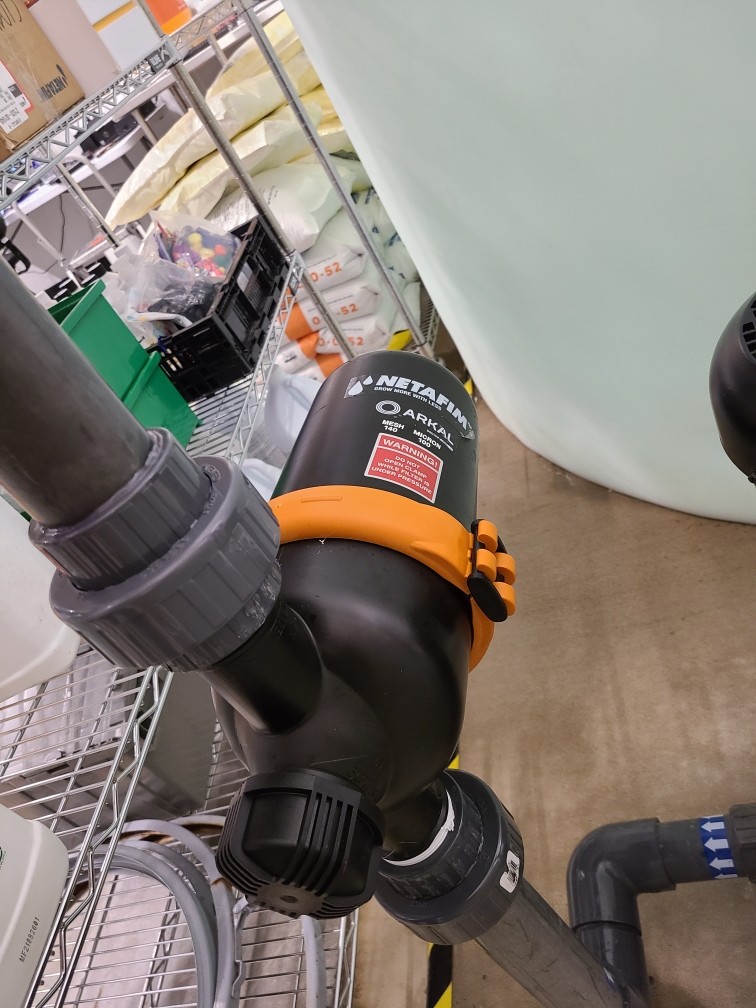
Screen and disc filters are commonly used to remove suspended particles from irrigation and process water. Selection considers the required filtration rating, flow rate, pressure loss, particle loading and cleaning method. Manual, semi-automatic or automatic cleaning may be appropriate depending on the system and operating duty.
Media and depth filtration
Media, depth and cartridge filtration can be used where the particle characteristics or required filtration level call for additional solids removal. The media type, filter area, loading rate, pressure drop, service interval and waste generated during cleaning or replacement should be considered as part of the design.
Microfiltration
Microfiltration uses membrane or fine-filter media to remove small suspended particles and colloidal material. It is generally used for finer solids separation than conventional screen, disc or media filtration while allowing dissolved salts and many smaller dissolved substances to remain in the water.
Ultrafiltration
Ultrafiltration (UF) uses a finer membrane barrier than microfiltration and can reduce very small suspended particles, colloids and microorganisms depending on the membrane and system design. UF is often used where consistent low-turbidity water is required or as pretreatment before another membrane process.
UF does not perform the same function as reverse osmosis. Dissolved salts and smaller dissolved molecules generally pass through an ultrafiltration membrane, so water chemistry must still be evaluated separately.
Nanofiltration
Nanofiltration (NF) is a pressure-driven membrane process positioned between ultrafiltration and reverse osmosis. It can reduce selected dissolved constituents, including many multivalent ions, while allowing more passage of some monovalent ions than a typical reverse-osmosis membrane.
NF can be useful where selective reduction of hardness or other dissolved constituents is desirable without applying the broader dissolved-solids rejection associated with RO. Actual performance depends on membrane selection, water chemistry and operating conditions.
Reverse osmosis
Reverse osmosis (RO) is a pressure-driven membrane process used to reduce dissolved salts and other dissolved constituents from source or process water. RO can provide a consistent treated-water basis for irrigation where the source-water chemistry requires substantial dissolved-solids reduction.
An RO system also produces a concentrate or reject stream. Feed-water quality, pretreatment, membrane recovery, concentrate management, operating pressure, cleaning requirements and treated-water demand all need to be considered when determining whether RO is appropriate.
Filtration and disinfection serve different purposes
Filtration can remove suspended particles and, depending on the technology, selected dissolved constituents or microorganisms. It should not automatically be treated as a complete disinfection process.
Where microbial control is required, filtration may be combined with UV, oxidizing disinfectants, heat or another treatment method appropriate for the water quality and application. The treatment process should define how performance will be monitored and what happens when operating conditions fall outside the intended range.
Match filtration to flow, pressure and operating conditions
Design flow
A filter must accommodate the expected operating flow without creating excessive pressure loss. Systems with multiple irrigation zones or varying demand may require evaluation across several operating conditions rather than one nominal flow rate.
Pressure and differential pressure
Filters require enough available pressure to pass the design flow and, where applicable, complete backwashing or automatic cleaning. Differential pressure can also provide useful information about filter loading and when a cleaning or service action is required.
Particle loading and cleaning frequency
Two water sources with similar flow rates can impose very different loads on a filter. Particle concentration, particle size, organic debris, source variability and seasonal conditions can affect filter loading and cleaning frequency.
Materials and water chemistry
Filter housings, membranes, seals, media and other wetted components should be compatible with the actual water chemistry and any chemicals used for cleaning or treatment. Compatibility should be confirmed from manufacturer information rather than assumed from the general filter type.
Plan for cleaning, backwash and reject water
Filtration does not make contaminants disappear. Screen, disc and media filters may generate backwash water, cartridge systems create spent filter elements, and membrane processes can produce concentrate streams. Those outputs need a defined disposal, treatment or recovery path.
Cleaning and backwash requirements also affect pumping, storage, drain capacity and controls. A filter that performs well hydraulically but cannot be serviced or cleaned efficiently can create unnecessary operational burden.
Where recovery of filter backwash, membrane concentrate or other process water is being considered, the filtration design should be coordinated with the facility’s water reclamation strategy.
Coordinate filtration with water storage
Water storage can provide equalization between the source, treatment equipment and irrigation demand. Tank location, turnover, pumping, treatment sequence and available storage volume can all influence how filtration equipment operates.
IWP coordinates filtration with water storage so filter production, tank capacity and downstream demand are considered together rather than as separate equipment decisions.
Monitor filter condition instead of relying on a universal service interval
Filter maintenance depends on the technology, water quality, loading, operating hours and manufacturer requirements. A fixed monthly inspection or quarterly replacement interval is not appropriate for every filtration system.
Useful maintenance indicators may include differential pressure, flow, treated-water quality, membrane performance, cleaning frequency and visual inspection. Maintenance planning should define what will be measured, the acceptable operating range and the action required when performance changes.
Frequently asked questions about commercial water filtration
What type of water filter is best for a commercial hydroponic system?
There is no single best filter for every facility. Selection depends on the source water, particle loading, dissolved-water chemistry, required flow and pressure, downstream equipment and the quality needed for irrigation or another process. Commercial systems commonly use multiple filtration or treatment stages because one filter type rarely addresses every requirement.
Do all hydroponic facilities need reverse osmosis?
No. Reverse osmosis is appropriate when dissolved constituents need to be reduced to meet the desired water quality. Some facilities may require only particulate filtration, while others may benefit from UF, NF, RO or another treatment process. Source-water analysis and crop or process requirements should drive the decision.
How often should water filters be cleaned or replaced?
The appropriate interval depends on filter type, particle loading, water quality, operating hours and manufacturer guidance. Differential pressure, flow, treated-water quality and inspection findings can provide better service indicators than a universal calendar interval.
Can commercial filters handle high irrigation flow rates?
Commercial filtration equipment is available across a wide range of flow capacities, but the filter must be selected and sized for the actual operating conditions. Required flow, allowable pressure loss, cleaning method, redundancy needs and future capacity should be evaluated before the equipment is selected.
Does filtration remove pathogens from hydroponic water?
Some membrane filtration technologies can reduce microorganisms, but performance depends on the membrane, system condition and operating requirements. Particulate filtration alone should not be assumed to provide disinfection. Where microbial control is required, filtration should be coordinated with an appropriate treatment and monitoring strategy.
Can filtration be upgraded in an existing greenhouse or indoor grow facility?
Often, yes. An upgrade should first review the existing water source, flow and pressure, available space, pumps, storage, controls and downstream equipment. Water testing and operating data can help determine whether the existing problem is primarily suspended solids, dissolved constituents, microbial risk or a combination of issues.
Discuss your water filtration requirements
Tell us about your water source, required flow, downstream equipment and the water-quality problem you are trying to solve. We can help define the filtration and treatment requirements, equipment, monitoring and integration needed for your complete water process.
Email service@waterprocess.com with your location, project stage and any available water analyses, flow requirements, equipment information or facility drawings.