
Hydroponic System Design and Drafting

Commercial hydroponic system design built around your operation
Hydroponic system design turns your operating requirements into coordinated drawings, calculations and equipment requirements. Integrated Water Process supports commercial greenhouses and indoor growing facilities by connecting treatment, storage, pumping, irrigation and controls. The resulting package helps your team review the design, coordinate installation and define the checks needed before operation.
Our Total Water Management approach considers the complete path of water through the facility, including source water, treatment, nutrient delivery, drainage and any proposed recovery. We serve projects across the United States, with particular focus on the Midwest and Mid-Atlantic.
Design builds on the operating basis established during hydroponic grow system planning. We review the Owner’s Project Requirements (OPR) and available process flow diagrams (PFDs), confirm the design scope and develop the technical detail needed for the next project stage.
Resolve the connections between equipment and operating requirements
The problem: individual equipment selections leave interfaces unresolved
Pumps, tanks, treatment packages and irrigation controls may be selected by different suppliers. Their connection sizes, operating ranges and control requirements still need to be coordinated. Equipment that appears suitable individually can create conflicts when assembled into a complete water system.
The impact: missing detail becomes a field decision
Unclear drawings can leave installers to interpret piping routes, valve locations or equipment connections. Unresolved flow, pressure or control requirements can also complicate startup. Late decisions may affect installation scope, service access and the checks needed to accept the system.
The design response: document how the complete system works
We develop the water-system design around agreed operating requirements and verified inputs. Drawings, calculations and equipment information make the system connections and responsibilities visible. Design reviews identify open questions before the package is released for its agreed purpose.
What commercial hydroponic system design covers
- Confirm the design basis: review crop needs, irrigation schedules, water demand, source conditions and the owner’s operating requirements.
- Coordinate treatment: connect source-water findings to the filtration, conditioning, disinfection or blending requirements relevant to the application.
- Develop storage arrangements: address usable volume, refill strategy, tank functions, level monitoring and equipment access.
- Calculate pumping and distribution requirements: evaluate operating flows, pressures and system losses for the agreed irrigation arrangement.
- Coordinate irrigation and nutrient delivery: define zone requirements and the interfaces with fertigation equipment.
- Document piping and instrumentation: identify equipment, valves, measurement points and their connections in the design package.
- Define control interfaces: record monitoring, operating modes, alarms and supplier coordination requirements within the agreed scope.
- Plan for service and expansion: address isolation, drainage, equipment clearances and any agreed future connections or recovery arrangements.
Drawings and documentation your project team can use
The design package depends on the project stage and agreed scope. Deliverables can include:
- An updated design basis and process flow diagrams that record the selected water process, operating assumptions and major equipment functions.
- Piping and instrumentation diagrams (P&IDs) that identify process equipment, piping connections, valves and measurement or control points.
- Water-room, equipment and piping layouts that coordinate placement, routes, connection details and maintenance access.
- Hydraulic calculations and equipment requirements that document the flow, pressure, storage and treatment assumptions used for selection.
- Equipment schedules and control requirements that support supplier coordination, identification and review of system interfaces.
- Installation notes and verification requirements that describe the checks and acceptance criteria needed for the agreed system functions.
Each issue should state its purpose and remaining open items so the team understands whether it is intended for review, pricing or installation. Procurement, installation and commissioning support are scoped separately. Responsibilities for detailed electrical design and controls programming are defined in the project scope and coordinated with the responsible suppliers or disciplines.
From operating requirements to a coordinated design package
1. Confirm the requirements and available information
Review the OPR, planning outputs, facility drawings and supplier information. Identify missing capacity or water-quality information and coordinate any further water testing and analysis needed to support design decisions.
2. Develop the process and design calculations
Refine the treatment, storage, pumping, irrigation and recovery approach. Establish the operating conditions and calculations needed to compare equipment and document the proposed system.
3. Coordinate drawings, equipment and controls
Develop P&IDs, layouts and schedules to the agreed level of detail. Review equipment connections, piping routes, access and control interfaces with the owner, facility team and relevant suppliers.
4. Review the design and resolve open items
Check the package against the operating requirements and available supplier data. Record decisions, revisions and responsibilities, including items requiring confirmation by another discipline or reviewing authority.
5. Issue the package and define the delivery handoff
Issue the drawings and documentation for their agreed purpose, with the relevant schedules, notes and verification requirements. Follow-on scopes can support system installation, testing and commissioning, and ongoing maintenance.
Design for precision, access and measurable operation
Water quality and treatment
Source-water analysis helps define the treatment and nutrient-management questions that the design must address. Relevant measures can include pH, alkalinity, hardness and electrical conductivity (EC), along with application-specific constituents. EC provides information about dissolved ionic salts; it does not identify individual nutrients.
Pumping, storage and irrigation
Precision means defining operating targets and acceptable deviations for flow, pressure, tank levels, irrigation timing and relevant water-quality measures. The design connects those requirements to pumps, tanks, distribution piping, valves and irrigation zones, with attention to the operating range and service access.
Controls and equipment interfaces
Level sensors, flow and pressure measurement, water-quality instruments and pump or valve controls should support defined operating functions. The design scope can document monitoring points, operating modes, alarms and interlocks so the responsible controls supplier can review and implement the agreed functions.
Documentation and facility coordination
Consistent equipment identifiers, drawing legends and revision records help the project team interpret the package. Backflow protection, drainage, electrical connections, discharge or reuse requirements and project-specific approvals are coordinated with the responsible disciplines and reviewing authorities within the agreed scope.
Review the related hydroponic irrigation systems, water storage, water filtration and irrigation pump solutions. Our water-engineering glossary explains commonly used terms.
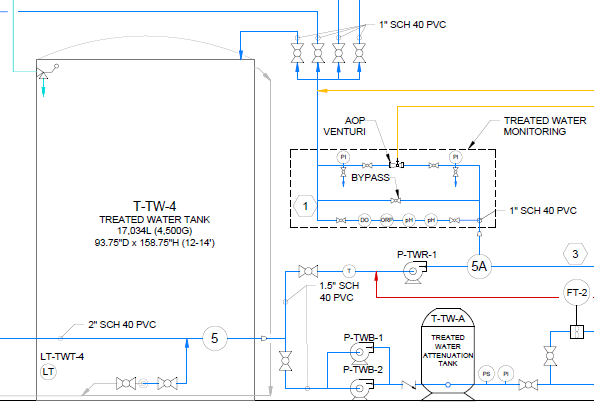
Drawing example: coordinating a treated-water process
The drawing below illustrates how a treated-water tank, pumps, valves and monitoring points can be documented together. A P&ID makes their connections and identifiers visible so the project team can review how water moves through the process and which conditions need to be measured or controlled. Equipment layouts address physical placement and access, while hydraulic calculations address required flow and pressure. Together, these documents support design review and preparation for installation. Operating performance is then checked through the project’s agreed testing and commissioning scope.
Frequently asked questions about hydroponic system design
How does design differ from hydroponic system planning?
Planning is pre-design work that establishes the owner’s requirements, system approach and information needed to proceed. Design develops that basis into coordinated drawings, calculations, equipment requirements and system interfaces. The level of detail and deliverables are agreed for the project stage.
Which drawings and documents can the design package include?
The agreed package can include process flow diagrams, piping and instrumentation diagrams, equipment and piping layouts, hydraulic calculations, schedules, control requirements and installation notes. We identify the required documents and their intended issue purpose before work begins.
Can you design changes to an existing commercial growing facility?
Yes. Design can address an expansion, an equipment replacement or a defined change to an existing water system. Available drawings, site observations, operating records and supplier data help establish the existing conditions; missing information is identified before the design relies on it.
How are pumps, tanks, filtration and irrigation equipment selected?
Equipment requirements follow the agreed operating basis, including source-water conditions, demand, irrigation scheduling, required flow and pressure, storage needs and maintenance access. We coordinate the proposed selections and supplier information so their operating ranges and interfaces can be reviewed together.
Does the design service include controls programming?
The water-system design can define measurement points, operating modes, alarm requirements and interfaces with pumps, valves and treatment equipment. Controls programming and detailed electrical design are separate responsibilities agreed in the project scope and coordinated with the responsible suppliers or disciplines.
Can design support continue through installation and commissioning?
Yes. Follow-on support can connect the design package to installation coordination, supplier questions, testing, commissioning and maintenance. We agree on responsibilities, acceptance checks and the support required for each phase before that work begins.
Discuss your hydroponic water-system design
Tell us about your facility, project stage and operating requirements. We can review the planning information already available and define the drawings, calculations and coordination needed for your design scope.
Email service@waterprocess.com with your location, project stage and available OPR, drawings or water analyses.