
Water Storage

Hydroponic water storage for commercial growing facilities
Integrated Water Process plans, specifies and supplies water storage systems for commercial greenhouses, indoor growing facilities and other controlled-environment agriculture (CEA) applications. Storage is planned as part of the complete water process rather than treated as an isolated tank purchase.
Our Total Water Management approach coordinates water storage with the source-water supply, treatment equipment, pumping, irrigation demand, nutrient delivery, water recovery, instrumentation and controls. The objective is to provide the usable storage capacity the facility needs while maintaining practical access, water quality and operating flexibility.
Water storage serves different parts of the water process
A commercial cultivation facility may need several different storage functions rather than one large tank. Depending on the project, water storage can include:
- Freshwater reserves: stored source water available for treatment, irrigation or other facility demands.
- Rainwater and condensate collection: storage for recovered water before evaluation, treatment or reuse.
- Irrigation and day storage: working-volume tanks that help coordinate treatment, nutrient delivery and irrigation demand.
- Drain and recovered-water storage: collection or equalization capacity for water entering a reclamation process.
- Nutrient and additive storage: dedicated storage selected specifically for the chemical, concentration and operating requirements.
These functions may require different materials, tank sizes, instrumentation, turnover rates and treatment strategies. Combining them into one storage approach without first defining their purposes can create water-quality, capacity and operating problems.

Four priorities when planning commercial water storage
1. Provide the required usable water volume
Tank capacity should be based on how the facility actually uses water. Relevant information can include peak and average irrigation demand, source-water availability, treatment-production rate, tank refill time, operating schedules and the desired reserve period.
The total tank volume is not always the same as usable operating volume. High- and low-level limits, overflow protection, pump suction requirements, treatment sequences and operating reserves can reduce the volume available for normal use.
2. Coordinate storage with water quality
Storage changes how long water remains in the process and how it interacts with temperature, treatment, circulation and the surrounding environment. Tank turnover, mixing, filtration, temperature management and monitoring should therefore be considered according to the type of water being stored and its intended use.
Depending on the application, useful measurements can include temperature, dissolved oxygen (DO), pH, electrical conductivity (EC), oxidation-reduction potential (ORP), tank level and other water-quality parameters. The appropriate measurements and treatment requirements should be based on identified operating needs rather than assumed for every tank.
Storage and circulation alone do not establish microbiological water quality. Where microbial control is required, filtration, disinfection, monitoring and water testing should be considered as separate parts of the treatment process.
3. Fit the facility and remain serviceable
Available floor area, ceiling height, access routes, structural requirements, installation sequence and future maintenance all influence tank selection. A tank that provides the required volume but cannot be installed, inspected, isolated or serviced efficiently can create long-term operating problems.
Modular arrangements can be useful where access, future expansion or phased construction makes a single large vessel impractical. The planning process should also account for valves, piping, pumps, instruments, overflows, drains and the working space needed around the tanks.
4. Connect storage to the rest of the water system
Water storage affects upstream and downstream equipment. Tank levels can influence pump suction conditions, available treatment time, irrigation capacity and the sequence in which equipment operates. Filling, transfer, treatment and irrigation controls should therefore be coordinated with the intended storage strategy.
Storage can provide a reserve when the primary water source is temporarily unavailable, but tank volume by itself does not protect the facility from every interruption. Pumping, power, treatment, controls and distribution must also remain available if continued operation during an outage is a project requirement.
Water storage materials and tank configurations
There is no single tank material that is best for every hydroponic or CEA application. The stored liquid, required volume, temperature, chemical compatibility, location, installation access, cleaning requirements and manufacturer limitations should be considered together.
Polyethylene tanks
Polyethylene tanks are widely used for commercial water storage and are available in many shapes and capacities. The specific tank should be checked for the intended liquid, temperature, indoor or outdoor location, UV exposure where applicable, fittings and manufacturer requirements.
Modular steel tanks with liners
Modular steel tank systems can provide larger storage volumes using components that are assembled at the facility. The liner provides the liquid-contact surface, so liner material, water chemistry, temperature, installation quality and manufacturer requirements are important parts of the selection.
Modular steel tanks should not be confused with flexible or collapsible storage vessels. They are different tank configurations with different structural, installation and operating considerations.
Fiberglass-reinforced plastic tanks
Fiberglass-reinforced plastic (FRP) can be appropriate where its structural and chemical-resistance characteristics fit the application. Resin system, construction, fittings and compatibility with the stored liquid should be confirmed for the actual service rather than assumed from the material category alone.
Concrete tanks and catchment structures
Concrete storage or catchment structures may be considered where large volumes, permanent construction or integration with the building makes them practical. Structural design, waterproofing, coatings where required, drainage, access and water-quality implications need to be addressed as part of the facility design.
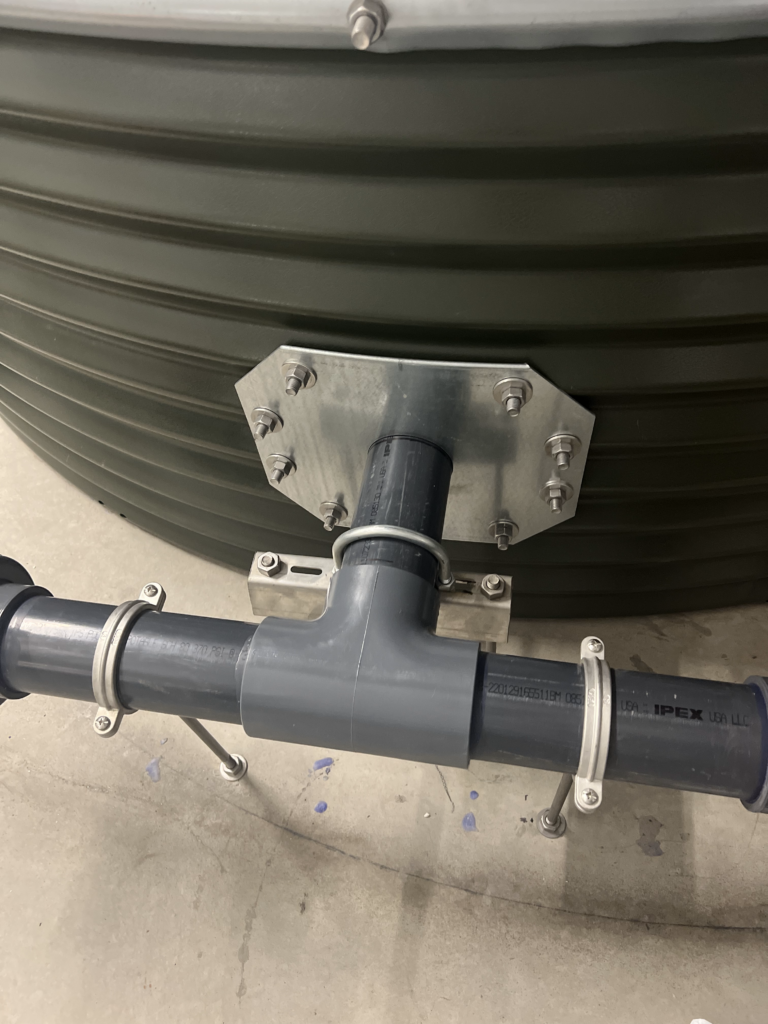
Size storage around demand, refill and reserve requirements
Water-storage sizing starts with the facility’s water balance rather than a universal number of gallons or days of storage. A useful assessment considers how much water the facility consumes, when that demand occurs, how quickly the source and treatment systems can refill the tanks, and what reserve objective the owner wants to maintain.
For example, a facility with a reliable source and treatment system may require a different reserve strategy than a facility with limited source capacity, long treatment cycles or significant exposure to supply interruptions. Growing method and irrigation strategy can also affect how quickly a water interruption becomes operationally important.
IWP’s hydroponic system planning process can establish these requirements before tank sizes and equipment are committed.
Coordinate storage with treatment, irrigation and recovery
Storage typically sits between other water processes rather than at the beginning or end of the system. Source-water treatment may occur before or after storage depending on the process, while irrigation, nutrient delivery and recovered-water systems can each require their own working volumes.
IWP coordinates storage with water filtration, commercial irrigation and water reclamation so tank volumes and operating sequences reflect the complete water process.

Plan monitoring, inspection and maintenance access
Tank design should make routine inspection and maintenance practical. Level instruments, valves, pumps, fittings, strainers, circulation equipment and treatment connections need appropriate isolation and service access.
Cleaning frequency should be established from the tank manufacturer’s requirements, stored-water quality, operating history, sediment or biofilm accumulation and inspection findings. A universal quarterly or crop-cycle cleaning interval is not appropriate for every installation.
Tank entry can present serious hazards and should not be treated as a routine cleaning method. Where personnel entry is contemplated, the applicable confined-space and facility safety requirements must be evaluated and the work performed by appropriately qualified personnel.
Frequently asked questions about hydroponic water storage
What is the best tank material for a commercial hydroponic facility?
There is no universally best material. Polyethylene, modular steel tanks with liners, FRP and purpose-built concrete storage can each be appropriate in different applications. Selection should consider the stored liquid, required capacity, chemical and temperature compatibility, installation access, location, maintenance requirements and manufacturer specifications.
How much water storage does my facility need?
Size storage from the facility water balance. Consider peak and average water demand, irrigation schedules, source reliability, source flow, treatment-production rate, refill time, usable tank volume and the desired reserve period. A fixed rule such as one day of storage may be useful as an early planning scenario, but it should not replace a project-specific capacity calculation.
Can modular or collapsible tanks be used for hydroponic water storage?
They can be appropriate in some facilities, but modular steel tanks and flexible collapsible tanks are different systems. Available space, access, structural requirements, stored liquid, liner or vessel compatibility, connections, service life and manufacturer limitations should be reviewed before selecting either approach.
How often should a hydroponic water storage tank be cleaned?
The appropriate interval depends on the type of stored water, sediment or biological accumulation, tank design, operating history and manufacturer guidance. Routine inspection should establish whether cleaning is needed. Cleaning procedures also need to account for isolation, drainage, treatment chemicals and personnel safety.
How should water quality be monitored in a storage tank?
Monitoring depends on what the tank contains and how the water will be used. Level and temperature are common operating measurements, while pH, EC, dissolved oxygen, ORP or other parameters may be useful for particular processes. Instrument readings do not by themselves demonstrate that water is free from microbial or chemical contaminants, so water testing and analysis may also be appropriate.
Discuss your water storage requirements
Tell us how your facility uses water, what needs to be stored and where the project stands. We can help define usable capacity, tank configuration, treatment connections, pumping, instrumentation and controls as part of the complete water process.
Email service@waterprocess.com with your location, project stage and any available water-use data, water analyses, equipment information or facility drawings.