

Originally published October 3, 2023. Updated October 2026.
Proportional dosing provides commercial growers with a relatively simple way to introduce fertilizers, acids, sanitizers, and other treatment chemicals into a flowing water stream.
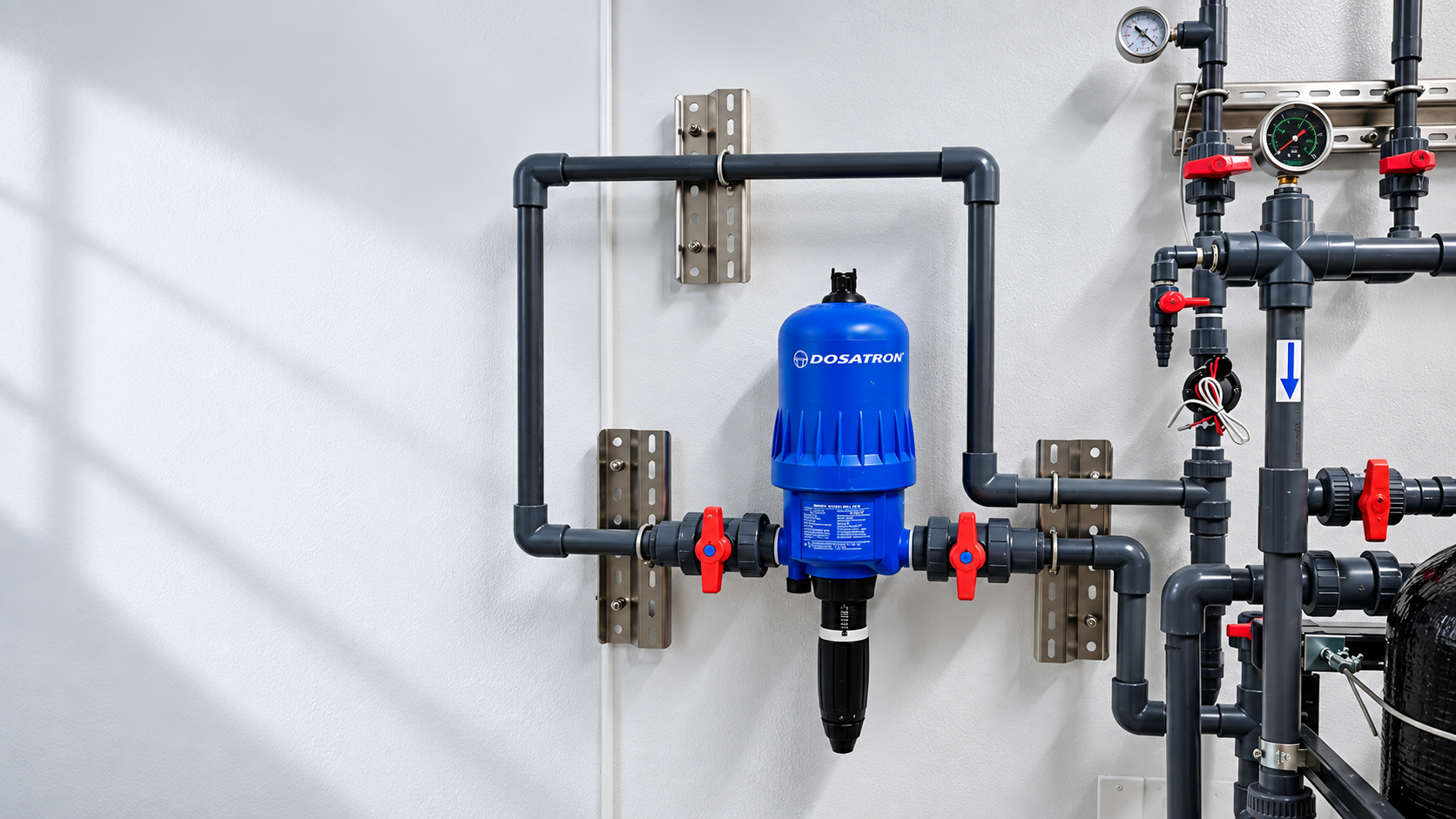
Dosatron water-powered dosing pumps are one technology that can be used for this purpose. When properly selected and integrated, proportional dosing can provide repeatable chemical injection without requiring a separate electrically driven metering pump.
The dosing pump itself, however, is only one part of the process. Flow, pressure, source-water quality, chemical compatibility, treatment objectives, controls, and downstream irrigation requirements all need to be considered when determining whether proportional dosing is appropriate for a commercial hydroponic system.
How Does Proportional Dosing Work?
A water-powered proportional dosing pump uses the flow of water through the device to drive its internal dosing mechanism.
As water passes through the unit, a concentrated solution is drawn from a separate chemical or nutrient container and introduced into the water stream at an adjustable ratio.
Because chemical injection is proportional to water flow, the amount of concentrate added generally increases or decreases as the water demand changes.
This can make proportional dosing useful in applications where a defined concentration or treatment ratio needs to be maintained over a variable water flow.

Dosatron An Ingersoll Rand Business
Where Can Dosatron Equipment Be Used?
Depending on the chemical, operating conditions, and specific equipment selected, proportional dosing can support several processes within a commercial hydroponic or greenhouse water system.
Applications may include:
- Fertilizer injection
- Nutrient stock solution dosing
- pH adjustment
- Water-treatment chemical injection
- Sanitation and disinfection programs
- Line-cleaning chemistry
- Equipment cleaning processes
- Other proportional chemical-injection applications
The correct application depends on the specific chemical and equipment materials. Chemical compatibility should always be verified before a dosing system is placed into service.
Proportional Dosing for Fertigation
Fertigation combines irrigation and nutrient delivery into the same water process.
In a commercial hydroponic system, proportional dosing can be used to inject concentrated fertilizer solutions into irrigation water at a defined ratio.
This approach can work well where the production strategy requires relatively stable recipes and predictable proportional dosing.
A typical system may include:
- Source or treated water
- Filtration
- Pressure regulation
- Proportional dosing equipment
- Stock solution tanks
- Mixing or contact piping
- pH and electrical conductivity measurement
- Irrigation distribution
The design should provide enough downstream mixing and measurement to verify that the intended solution reaches the irrigation system.
Flow and Pressure Matter
A proportional dosing pump must operate within the hydraulic conditions specified for the particular model.
Important design criteria include:
- Minimum operating flow
- Maximum operating flow
- Minimum inlet pressure
- Maximum allowable pressure
- Pressure loss through the dosing device
- Required injection ratio
- Chemical viscosity
- Suction conditions
A dosing system selected only around pipe size can perform poorly if the actual irrigation demand falls outside its effective operating range.
For systems serving multiple irrigation zones, the lowest and highest expected flow conditions should both be evaluated.
Filtration Protects Dosing Equipment
Water quality directly affects dosing equipment reliability.
Suspended solids, scale, organic material, and other debris can interfere with internal components, check valves, seals, and downstream irrigation equipment.
Appropriate filtration upstream of the dosing system can reduce these risks and improve serviceability.
The required filtration depends on both the dosing equipment and the downstream irrigation system. Learn more about water filters for commercial hydroponics.
Water Chemistry Still Needs to Be Understood
Proportional dosing does not eliminate the need to understand the source water.
Parameters such as alkalinity, hardness, pH, electrical conductivity, dissolved minerals, and source-water variability can affect how injected chemicals behave after they enter the water stream.
For example, an acid dosing ratio that performs appropriately with one source water may produce a different result if alkalinity changes significantly.
Baseline water testing and analysis can help define those conditions before a dosing strategy is finalized.
Proportional Dosing vs. Closed-Loop Fertigation
Proportional dosing and closed-loop fertigation controls solve different problems.
A proportional dosing pump primarily injects concentrate according to water flow and the selected dosing ratio.
A more advanced fertigation system may continuously measure parameters such as pH and electrical conductivity and adjust individual dosing channels based on feedback from those sensors.
Closed-loop systems can also support:
- Multiple nutrient stock solutions
- Automatic recipe changes
- Crop-specific programs
- Dynamic EC targets
- Dynamic pH control
- Batch management
- Data logging
- Alarm management
- Integration with greenhouse controls
That does not make one approach inherently better than the other. The correct level of automation depends on the production requirements.
Simple proportional dosing may be appropriate for one application, while a multi-channel closed-loop fertigation system may be justified for another.
Precision Starts With Defined Requirements
Precision horticulture requires more than installing accurate equipment. The required concentration, allowable deviation, flow range, water chemistry, and verification method should be defined before the dosing system is selected.
Important questions include:
- What chemical is being injected?
- What concentration is required?
- What variation is acceptable?
- What is the minimum system flow?
- What is the maximum system flow?
- What pressure is available?
- How variable is the source water?
- Where will the final concentration be measured?
- Does the system require automatic feedback control?
- What happens if chemical injection stops?
Answering these questions first makes it easier to determine whether proportional dosing is the correct technology.
Dosing System Layout Matters
Installation details influence both performance and maintenance.
A practical dosing assembly may require:
- Isolation valves
- Upstream filtration
- Pressure gauges
- Flow measurement
- Bypass piping
- Sampling points
- Backflow protection
- Drain provisions
- Chemical containment
- Accessible suction tubing
- Space for service and component replacement
These details can make a significant difference when operators need to calibrate, troubleshoot, flush, or maintain the equipment.
Verify Performance After Installation
A dosing system should be tested after installation rather than assumed to be correct because the adjustment dial is set to a particular value.
Commissioning may include:
- Verifying water flow
- Confirming operating pressure
- Checking chemical suction
- Measuring actual injection rate
- Confirming downstream mixing
- Measuring pH or EC where applicable
- Testing the system at minimum and maximum expected flow
- Checking bypass and isolation functions
- Documenting the final operating settings
These measurements establish a baseline for future maintenance and troubleshooting.
Dosatron as Part of a Complete Irrigation System
Integrated Water Process works with equipment manufacturers and technology providers, including Dosatron, to integrate specialized equipment into complete commercial water systems.
The objective is not simply to install a dosing pump. The objective is to coordinate dosing with the source water, filtration, pumping, storage, fertigation, irrigation, controls, and operating requirements of the facility.
Our commercial hydroponic irrigation systems are developed around defined flow, pressure, water-quality, and production requirements.
Design Before You Buy
Proportional dosing equipment is relatively compact, but its performance depends on the system surrounding it.
Integrated Water Process can evaluate dosing requirements during hydroponic system design, coordinate the equipment during installation, and verify performance during startup and commissioning.
This Total Water Management approach helps ensure that dosing technology is selected as part of the complete water process rather than as an isolated component.
Need Help With Fertigation or Chemical Injection?
Whether you are considering a new proportional dosing system, upgrading an existing fertigation process, or troubleshooting inconsistent chemical injection, Integrated Water Process can help define the requirements and develop a practical solution.