

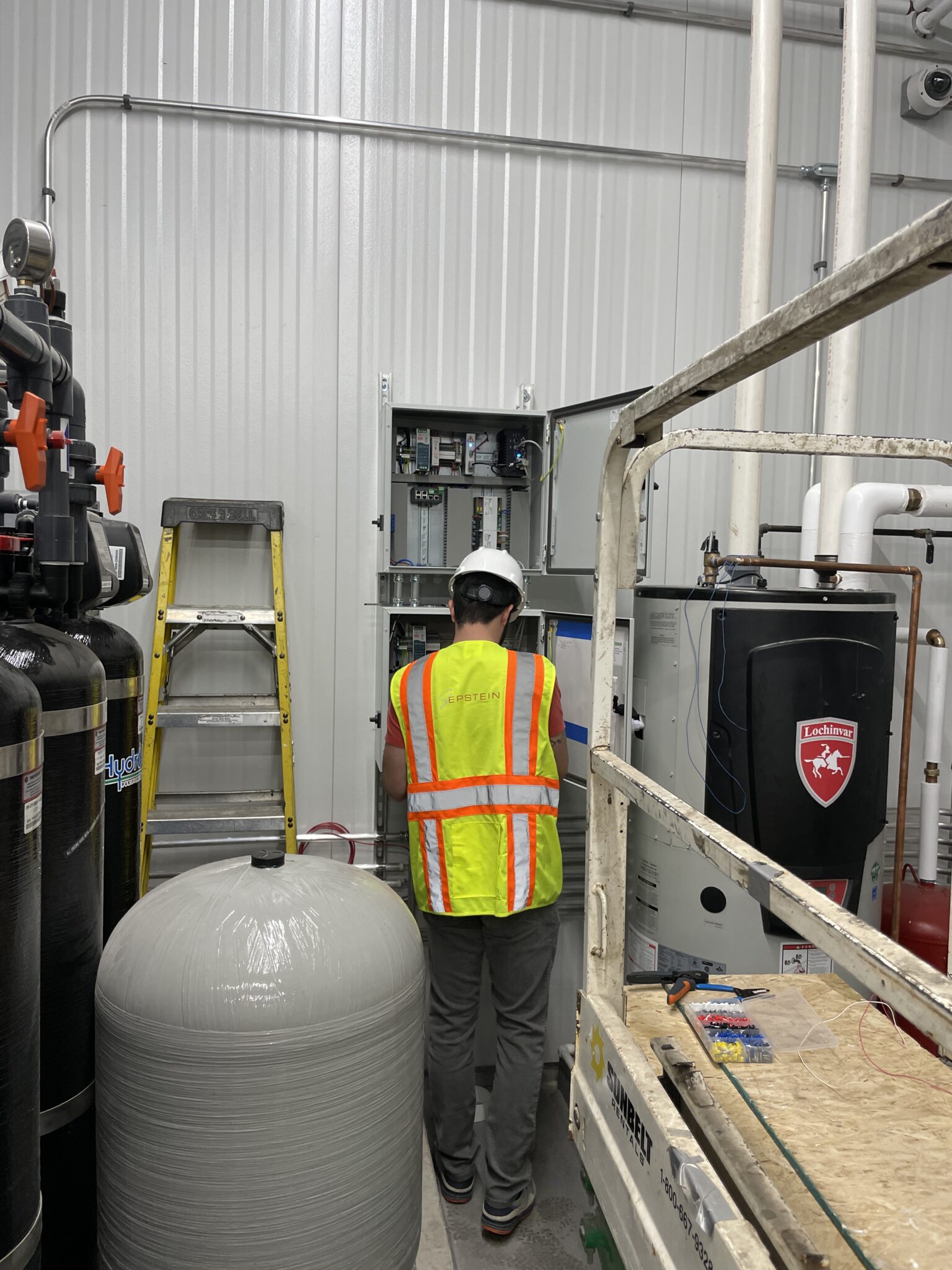
Originally published September 26, 2019. Updated October 2026.
Commissioning is the process of verifying that a water system has been installed, configured, tested, and documented so it performs according to the project’s defined requirements.
For a commercial hydroponic or greenhouse facility, this means more than confirming that pumps turn on and water reaches the crop. Tanks, pumps, filtration, treatment, fertigation, irrigation, instrumentation, controls, alarms, and operating sequences must work together as one complete process.
Commissioning provides a structured way to identify problems before they become production problems.
Why Commission Hydroponic Water Systems?
A water system can be mechanically complete and still be unprepared for reliable operation.
Common issues discovered during commissioning include:
-
- Incorrect pump rotation or operating pressure
- Improper valve positions
- Unexpected pressure loss
- Incorrect sensor scaling
- Incomplete control sequences
- Missing or incorrect alarm setpoints
- Improper tank level controls
- Incorrect dosing or fertigation configuration
- Flow imbalance between irrigation zones
- Equipment that has not been coordinated with downstream requirements
Finding these issues during a controlled startup is generally easier than diagnosing them after crops are relying on the system.
Startup Is Not the Same as Commissioning
Equipment startup is an important part of the process, but startup and commissioning are not the same thing.
A manufacturer or installer may start an individual pump, controller, filter, dosing system, or treatment device and confirm that the equipment operates. Commissioning evaluates whether that equipment performs correctly as part of the complete water process.
For example, a distribution pump may run properly on its own while still failing to provide adequate pressure at the most hydraulically remote irrigation zone. A dosing system may function correctly while receiving the wrong flow signal. A tank level sensor may display a value while being incorrectly scaled in the control system.
Commissioning evaluates these interfaces.
Start With the Owner’s Project Requirements
Effective commissioning begins before startup.
The system should have clearly defined operating requirements that describe what it is expected to accomplish. These requirements may be documented through an Owner’s Project Requirements (OPR), design criteria, control narrative, process description, drawings, equipment schedules, or other project documentation.
Typical water-system requirements include:
- Design flow rates
- Required distribution pressures
- Water storage volumes
- Tank operating levels
- Water-quality targets
- Filtration requirements
- Fertigation and dosing requirements
- Irrigation zone demands
- Control sequences
- Alarm limits
- Backup operating modes
- Water recovery or reuse requirements
If these requirements are not defined, it becomes difficult to determine whether the completed system is actually performing as intended.
Integrated Water Process addresses these requirements during hydroponic grow system planning and hydroponic system design.
Pre-Functional Checks
Before functional testing begins, the system should be inspected to confirm that the equipment and infrastructure are ready for operation.
Pre-functional checks may include verification of:
- Equipment installation
- Piping connections
- Valve orientation and position
- Electrical power
- Pump rotation
- Instrumentation installation
- Sensor wiring
- Control-panel connections
- Filter installation
- Drain and overflow routing
- Equipment labeling
- Safety devices
These checks help prevent basic installation problems from interfering with functional performance testing.
Functional Performance Testing
Functional performance testing verifies how the water system behaves under actual operating conditions.
The specific tests depend on the system, but may include:
- Measuring pump flow and discharge pressure
- Verifying irrigation-zone flow and pressure
- Confirming tank fill and drawdown sequences
- Testing automatic valve operation
- Verifying filter differential pressure
- Checking treatment-system flow rates
- Confirming dosing and fertigation operation
- Testing water-level controls
- Verifying backup and manual operating modes
- Confirming system response to changing demand
The objective is not simply to confirm that individual pieces of equipment operate. The objective is to verify that the complete process performs within its defined operating targets.
Commissioning Pumps and Distribution Systems
Pumping systems are a critical part of commercial hydroponic irrigation infrastructure.
Commissioning should verify that the selected pumps operate within an appropriate range and provide the intended flow and pressure through the actual installed piping system.
Testing may include:
- Suction conditions
- Discharge pressure
- Operating flow
- Variable frequency drive settings
- Pressure-control response
- Minimum and maximum speed limits
- Lead-lag operation where multiple pumps are used
- Low-water or dry-run protection
- High-pressure alarms
Measured performance should be compared with the design requirements rather than relying solely on equipment nameplate ratings.
Commissioning Filtration and Water Treatment
Filtration and water-treatment equipment should also be tested as part of the complete process.
Depending on the facility, commissioning may verify:
- Filter flow rates
- Clean and dirty differential pressure
- Backwash sequences
- Membrane operating pressures
- Recovery and reject flows
- pH adjustment
- Disinfection equipment
- Oxygen-transfer equipment
- Water-quality instrumentation
- Equipment interlocks
Testing should confirm both equipment performance and how the treatment process interacts with storage, pumping, fertigation, and irrigation.
Learn more about commercial hydroponic filtration and other water system solutions.
Commissioning Fertigation and Dosing Systems
Fertigation equipment must operate accurately within the hydraulic conditions of the installed system.
Commissioning can include verification of:
- Source-water flow
- Dosing pump operation
- Stock-tank connections
- Injection sequences
- pH measurement and control
- Electrical conductivity (EC) measurement and control
- Mixing and recirculation
- Batch volume
- Alarm conditions
- Recipe or setpoint changes
Where practical, field measurements should be compared with controller values to confirm that instrumentation and process conditions agree.
Controls, Sensors, and Alarms
A modern hydroponic water system often depends on controls to coordinate equipment that may have been supplied by several different manufacturers.
Commissioning should verify more than whether data appears on a screen.
Important checks may include:
- Sensor calibration
- Analog signal scaling
- Digital input status
- Valve and pump outputs
- Automatic operating sequences
- Manual operating modes
- Alarm setpoints
- Alarm delays
- Equipment interlocks
- Communication between control systems
Fault conditions should also be tested where practical. A control sequence cannot be considered fully verified if only normal operation has been tested.
Test the System Under Realistic Conditions
A system can appear to operate correctly at low demand and still experience problems during peak production.
Where possible, commissioning should test representative operating conditions, including:
- Peak irrigation demand
- Multiple irrigation zones
- Tank refill during irrigation
- Changing pump demand
- Filter loading
- Low tank levels
- Equipment faults
- Loss of sensor signals
The closer the test conditions are to actual production conditions, the more useful the commissioning process becomes.
Document the Results
Commissioning should produce documentation that becomes part of the operating record for the facility.
Useful commissioning documentation may include:
- Completed checklists
- Measured flow and pressure data
- Water-quality measurements
- Control setpoints
- Alarm settings
- Deficiency lists
- Corrective actions
- Final equipment settings
- Updated drawings
- Operator instructions
This information establishes a baseline that can later be used for troubleshooting, maintenance, and system optimization.
Operator Training Is Part of Commissioning
A technically functional system is not complete if the operations team does not understand how to use it.
Operators should understand:
- Normal system operation
- Startup and shutdown procedures
- Manual operating modes
- Alarm response
- Filter maintenance
- Pump operation
- Sensor maintenance and calibration
- Water-quality monitoring
- Basic troubleshooting
Training should be based on the actual installed system rather than relying only on individual equipment manuals.
Commissioning Creates a Performance Baseline
One of the most valuable results of commissioning is establishing how the system performed when it was placed into service.
Recorded flow, pressure, water quality, pump settings, control parameters, and alarm values create a reference point for future troubleshooting.
If system performance changes six months or two years later, operators and service technicians can compare current conditions with the commissioning baseline rather than starting from assumptions.
Integrated Water Process Commissioning
Integrated Water Process provides hydroponic testing and commissioning for commercial greenhouse and controlled environment agriculture water systems.
Our commissioning work can include pumps, tanks, filtration, treatment, fertigation, irrigation distribution, instrumentation, controls, alarms, and system operating sequences.
Because IWP works across planning, design, installation, commissioning, and maintenance, commissioning is treated as a continuation of the engineering process rather than a standalone equipment startup.
Ready to Commission a Water System?
Whether you are preparing a new hydroponic facility for production or troubleshooting an existing system, commissioning provides a structured way to verify performance before small issues become operational problems.